AI transformation is the deliberate redesign of how an organization makes decisions and completes work with AI. A practical AI transformation strategy for a lean team starts with one recurring workflow: inventory it, choose a bounded production job, define ownership and human review, run it in shadow mode, measure business value, and scale only after quality and control thresholds hold.
| Stage | Decision to make | Accountable owner | Evidence required to advance |
|---|---|---|---|
| 1. Inventory | Which recurring workflows consume time or delay decisions? | Operations lead | A workflow register with frequency, effort, inputs, outputs, and pain points |
| 2. Select | Which job is valuable, bounded, reviewable, and reversible? | Business owner | One production candidate with a named user and a clear output |
| 3. Baseline | What does the current process cost and how well does it perform? | Workflow operator | Current volume, labor, elapsed time, defects, rework, and downstream result |
| 4. Contract | What may the AI read, decide, write, and never do? | Business owner | An approved operating contract, permissions, review point, and stop conditions |
| 5. Shadow | Would the output pass without affecting live work? | Domain reviewer | Representative parallel runs that meet the agreed acceptance thresholds |
| 6. Release | Does the workflow create value under controlled production conditions? | Business owner | Accepted outputs, intervention time, run cost, failures, and user adoption |
| 7. Scale or stop | Is the result repeatable enough to become normal operations? | Executive sponsor | Positive net benefit, stable controls, an owner, and a maintained procedure |
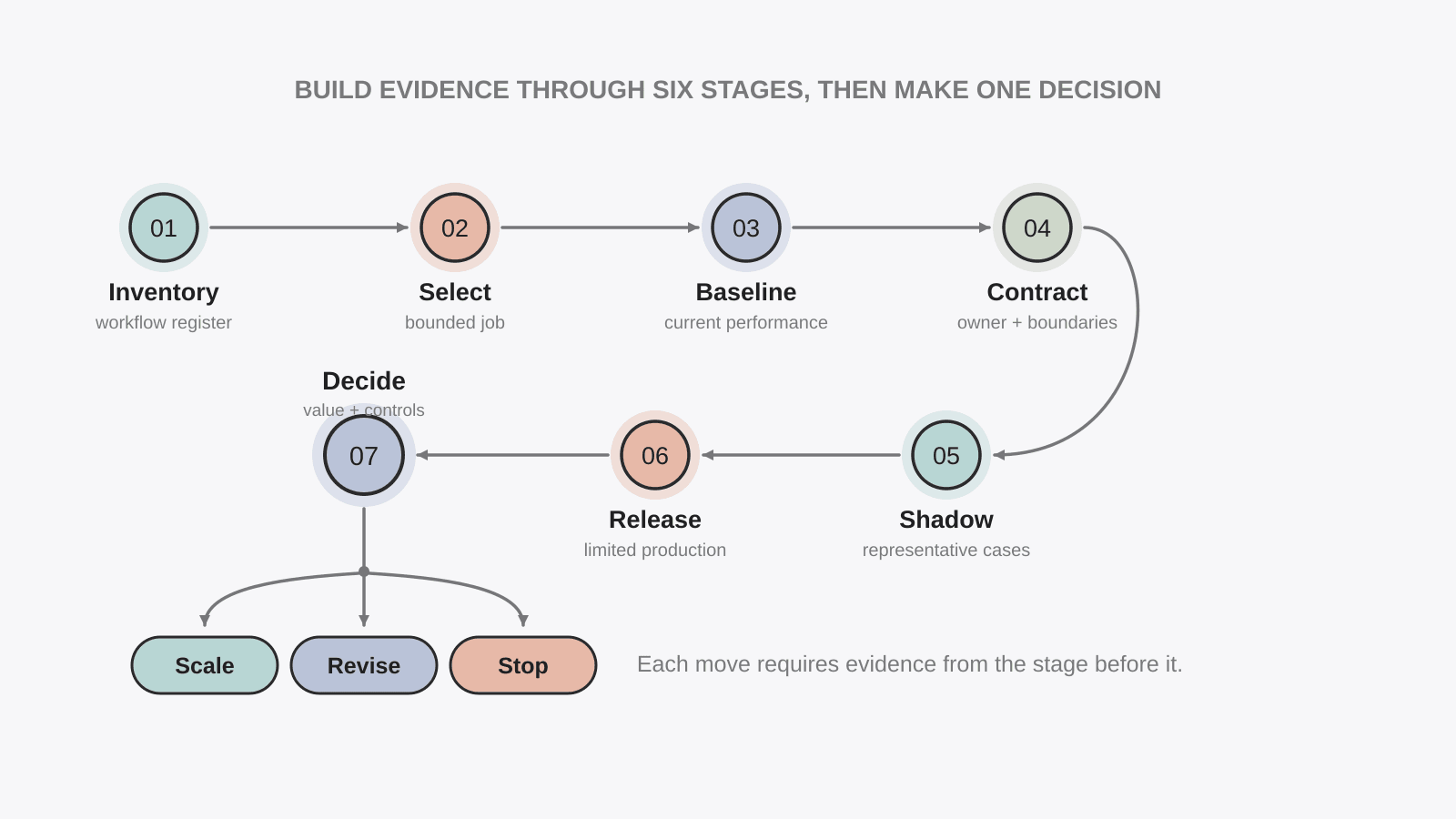
Figure 1. Advance only when the prior stage has produced reviewable evidence.
What AI transformation means for a lean team
For a lean team, AI transformation means a recurring unit of work changes its method, controls, ownership, and economics because AI is now part of the process. The first goal is one production workflow with a verifiable output, a named owner, and a safe way to stop.
IBM defines AI transformation more broadly as adopting and integrating AI into operations, products, and services. The workflow-level definition makes the first decision inspectable for a ten-person team. A new chat account doesn't meet that bar. A weekly growth review that gathers source data, flags tracking gaps, drafts the analysis, and waits for an owner to approve the interpretation does.
AI transformation vs. digital transformation
Digital transformation makes information and processes available through software. AI adds probabilistic judgment, generation, and adaptation to those digital processes. That changes the control problem.
| Digital transformation | AI transformation |
|---|---|
| Moves a paper or manual process into a digital system | Redesigns who or what performs judgment inside the process |
| Usually follows explicit rules and expected outputs | Can produce variable outputs from the same workflow shape |
| Tests whether the system executed the specified logic | Tests output quality, evidence, permissions, and exception handling |
| Trains people on a new interface | Changes decision rights, review work, escalation, and accountability |
The phrase AI digital transformation often describes the overlap. The sequencing still matters. If the source data cannot be accessed safely, the output has no owner, or nobody can say what a correct result looks like, adding AI will expose those gaps rather than resolve them.
For lean teams, the practical goal is a small portfolio of production workflows with clear owners. McKinsey's current AI transformation manifesto makes a similar strategic point: focus on the few economic points that matter and keep business leaders accountable for the result. The rest of this guide turns that principle into an operating sequence.
Build an AI transformation strategy in seven stages
A lean AI transformation strategy moves one workflow through seven evidence gates: inventory, select, baseline, contract, shadow test, limited release, and a scale-or-stop decision. Each gate names an accountable owner and requires evidence before the next stage. The order matters because automation amplifies whatever the workflow already contains.
Treat this as an AI transformation roadmap of decision gates, not calendar milestones. A stage can take days or weeks depending on the workflow's consequence and the quality of available evidence.
1. Inventory workflows, not AI ideas
Start with a week of work, not a list of model features. Ask each operator to name work that repeats, crosses tools, waits in queues, or ends in the same kind of artifact.
Capture one row per workflow:
| Field | Question |
|---|---|
| Trigger | What starts the work: a schedule, an incoming event, or a person? |
| Sources | Which systems contain the facts needed to complete it? |
| Decisions | Where does a person interpret, prioritize, or choose? |
| Output | What finished artifact or system change ends the job? |
| Frequency | How often does the work occur, and how uneven is the volume? |
| Current effort | How much active time and waiting time does one case require? |
| Exceptions | Which cases leave the normal path, and why? |
| Consequence | What happens when the work is late or wrong? |
People often describe the job as “being busy” until someone asks for the magic-wand fix. vm0's research on why workflows remain manual documents that discovery problem across 22 interviews. If your team cannot name candidates, use AI agent examples with concrete triggers, outputs, and approval points to recognize a workflow shape, then write down your own trigger, sources, output, and approval point. Do not copy a use case whose business problem you do not have.
2. Select the first production use case
The first workflow should be valuable enough to matter and safe enough to study. Favor work with a visible output, accessible source systems, frequent repetition, and a human who can judge the result quickly.
| Selection question | Better first candidate | Poor first candidate |
|---|---|---|
| Can a reviewer tell whether the output is correct? | A sourced internal brief | An open-ended strategic recommendation |
| Can the action be reversed? | A draft, label, or proposed update | A payment, deletion, or public send |
| Is the scope bounded? | One inbox, time window, and output format | “Improve operations across the company” |
| Is the input available? | Connected records with known ownership | Data that must be copied from several private stores |
| Does it recur? | Daily, weekly, or event-driven work | A one-off project with no repeat path |
The inbox morning brief example shows the shape. The workflow reads a defined Gmail window, ranks what needs attention, and posts one Slack brief. Its write scope explicitly excludes moving, deleting, labeling, archiving, forwarding, or answering email. That boundary makes the output useful while keeping the first release reversible.
Avoid picking a company-wide assistant as the first use case. “Everyone can ask anything” has no stable denominator, no consistent reviewer, and no clear point of failure. It creates activity before it creates evidence.
3. Baseline the current workflow
Measure the human process before changing it. Otherwise every improvement claim becomes a story told after the result is known.
For a representative sample, record:
- Cases per week or month
- Active labor minutes per case
- Elapsed time from trigger to finished output
- First-pass acceptance and rework
- Exceptions, defects, and their consequences
- Cost of the systems or outside labor used
- The downstream outcome the workflow is supposed to affect
Write down the unit of analysis. “Hours saved” means little if one person counts a whole afternoon while another counts only keyboard time. Choose one completed report, one triaged inbox window, one reconciled account, or another observable unit.
Do not invent a monetary value for speed. If a faster report changes a decision, document that link. If the team simply receives the same report sooner, report the cycle-time change and leave revenue out.
4. Write the operating contract
An AI transformation strategy becomes executable when the first workflow has a contract. This is a short operating document, not a policy binder.
| Contract field | Required decision |
|---|---|
| Purpose | Which business result does the workflow support? |
| Owner | Who is accountable for outcome, budget, and continuation? |
| Operator | Who inspects runs and maintains the procedure? |
| Inputs | Which sources and time windows may be read? |
| Permissions | Which actions are allowed, denied, or time-limited? |
| Output | What format, destination, and source evidence are required? |
| Human review | Who reviews, at what point, and against which criteria? |
| Failure threshold | Which defect pauses the workflow immediately? |
| Escalation | Who receives unknowns, exceptions, or blocked access? |
| Audit evidence | Where are inputs, actions, decisions, and approvals recorded? |
| Expiry | When will the owner reapprove, revise, or retire the workflow? |
This distinction is concrete in Zero. A workflow is the reusable procedure, including its goal, inputs, output, boundaries, and references. An automation attaches the trigger after the manual workflow works. Keeping those decisions separate prevents a schedule from repeatedly firing a procedure that has never passed review.
Permissions belong in the contract, too. Zero's permission model separates a member's connection, an agent's authorization, and the named actions that agent may request. Grants can be time-limited, and a workflow that prepares a draft can be denied the final send action. Whatever platform you use, require an equivalent answer: who supplied the credential, what may the system do with it, and how quickly can access be revoked?
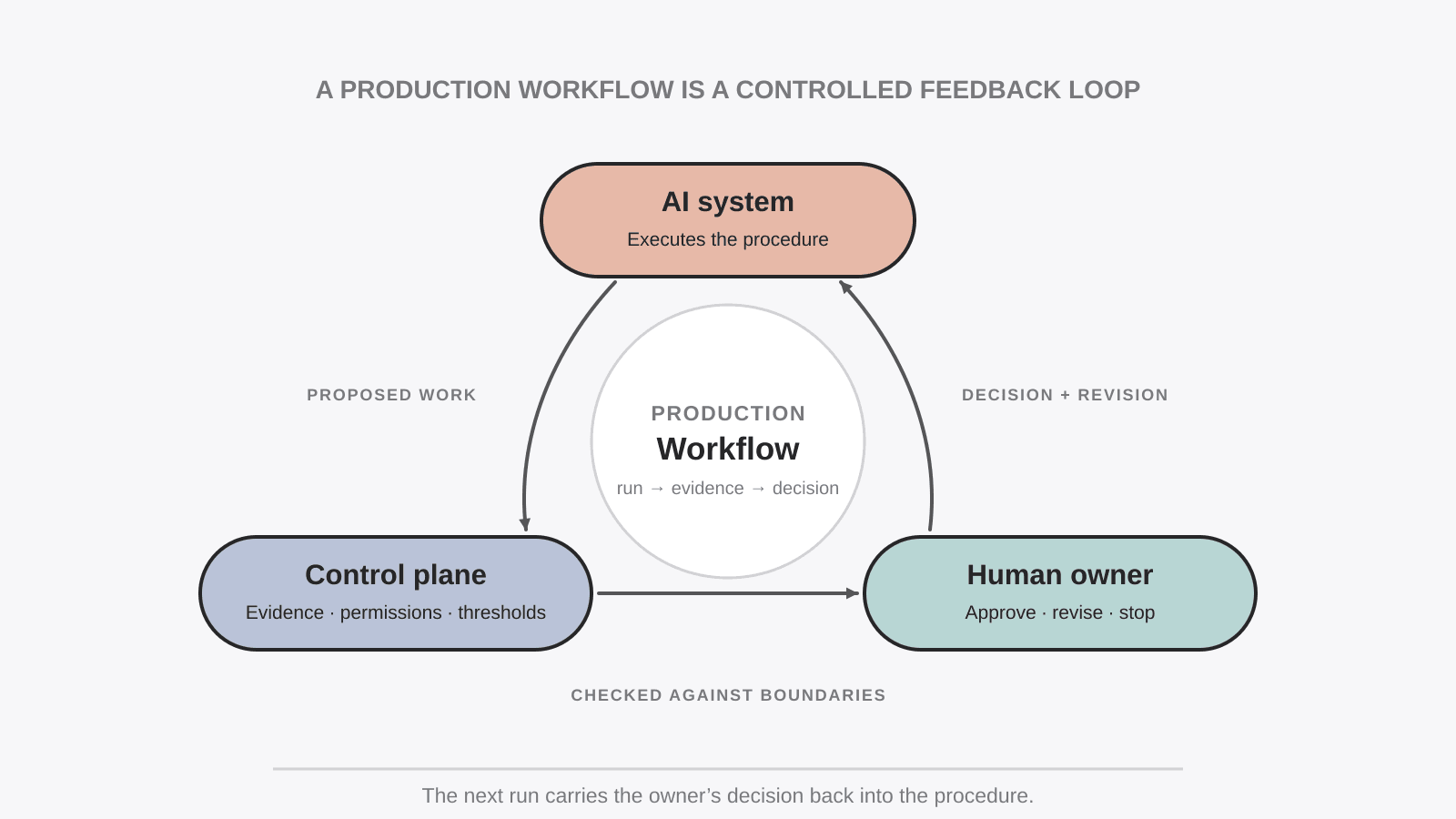
Figure 2. The operating loop separates AI execution, control checks, and the human decision.
5. Run in shadow mode and set failure thresholds
Shadow mode means the AI performs the workflow without changing the live process. Feed it completed historical cases or run it beside the current operator. Compare the outputs against the same acceptance checklist.
Use representative inputs, including ordinary cases, edge cases, missing data, and conflicting sources. A polished happy-path demo proves very little.
Define failure classes before the run:
| Failure class | Examples | Recommended response |
|---|---|---|
| Critical | Unauthorized action, exposed sensitive data, fabricated source, unapproved external commitment | Zero tolerance; stop the run and investigate before any restart |
| Material | Missing a required item, unsupported explanation, wrong priority, failed system update | Set a maximum rate based on business consequence; pause expansion when breached |
| Minor | Formatting, ordering, naming, or a low-impact omission | Correct the procedure and track recurrence |
| Data or system block | Missing permission, unavailable source, broken instrumentation, stale record | Escalate as “unknown” or “blocked”; never guess around it |
The budget variance commentary example is a useful pattern for this stage. Explanations require source evidence, ledger access remains read-only, and an undocumented variance becomes a private owner question. The workflow's quality depends as much on preserving “unknown” as on drafting the lines it can explain.
6. Release to limited production with human review
Move from shadow mode to a small production slice: one operator, one source, one customer segment, or one recurring window. Keep the old process available until the new path has survived real exceptions.
Set the review point from the action's consequence:
| Action type | Initial review design |
|---|---|
| Read-only internal analysis | Review every output during the pilot, then sample after stable acceptance |
| Draft or reversible update | Approve the artifact before anyone relies on it |
| Internal state change | Require confirmation until rollback and exception handling are proven |
| External, financial, destructive, or legally binding action | Keep pre-execution human approval and separate final-action permissions |
Human review is a control only when the reviewer has time, criteria, and authority to reject. “A person is in the loop” is not enough. Measure how long review takes, what gets changed, and whether reviewers begin approving without reading.
When you add a trigger, start narrow. The automation documentation recommends inspecting the first runs, using tight event filters, confirming the time zone, and disabling the automation when debugging. The connector documentation also makes connection and authorization separate decisions, which helps prevent a shared tool connection from becoming broad agent access.
7. Scale, revise, or stop
Scaling means the workflow becomes part of normal operations with a maintained owner, documented controls, and a repeatable economic case. It does not mean buying seats for every employee.
Scale when four conditions hold:
- The business metric improved against its baseline.
- Quality and critical-risk thresholds held across representative production work.
- Review and maintenance effort did not erase the benefit.
- Intended users adopted the new path instead of running a parallel manual process.
Revise when the use case remains valuable but errors cluster around a fixable source, instruction, permission, or handoff. Stop when the outcome is weak, adoption stays low, or safe operation requires more review than the workflow removes.
This is the point where AI operations transformation becomes an owned operating capability. Save the proven procedure, keep its trigger and permissions explicit, and reuse only the parts that genuinely transfer to the next workflow.
Governance without an enterprise program
Lean teams do not need a committee for every pilot. They do need named accountabilities. One person may hold several roles, but the roles should remain visible.
| Role | Accountable for |
|---|---|
| Business owner | Outcome, budget, priority, risk acceptance, and the scale-or-stop decision |
| Workflow operator | Daily run health, exceptions, procedure changes, and user feedback |
| Domain reviewer | Acceptance criteria, sampled output review, and material-error classification |
| Platform or data owner | Access, connector health, logging, retention, and revocation |
Maintain a one-page register for every production workflow. Include the owner, purpose, data sources, permissions, review step, model or service provider, current version, failure thresholds, last review date, and kill switch. This is enough to answer the uncomfortable questions after an incident: what ran, under whose authority, against which rule, and who stopped it?
Use an established risk framework to check the blind spots. The voluntary NIST AI Risk Management Framework covers governance, mapping context, measuring risk, and managing it across the AI lifecycle. NIST's Generative AI Profile adds guidance for risks specific to generative systems. A lean team can apply those questions to each workflow rather than trying to implement a company-wide control system on day one.
For a deeper treatment of agent autonomy, audit trails, and credential boundaries, see vm0's guide to the shift from copilot to colleague. Keep this transformation guide focused on operating ownership: the business owner still owns the result even when another team supplies the model, connector, or platform.
How to evaluate an AI transformation platform
Evaluate an AI transformation platform by what it makes controllable and observable at the workflow level. It should preserve the procedure, separate triggers from instructions, restrict tool actions, show source evidence and run history, place approval before consequential actions, and expose enough cost and exception data to support a scale-or-stop decision.
Feature count is a weak buying criterion. Ask a vendor to demonstrate one real workflow from trigger to accepted output, including a blocked permission, a failed run, a human rejection, and the evidence available afterward.
| Buying question | Evidence to request | Warning sign |
|---|---|---|
| Can the procedure be owned and revised? | A named workflow, owner, current version, and change history | The logic exists only inside one person's prompt or chat |
| Can access be constrained? | Separate connections, agent authorization, named actions, expiry, and revocation | Connecting an account grants broad access by default |
| Can review sit at the risky boundary? | Approval before external, financial, destructive, or binding actions | Review happens only after the action is complete |
| Can an operator reconstruct a run? | Sources, requested actions, outputs, errors, timestamps, and approvals | Only the final response is visible |
| Can the team measure one completed job? | Run cost, review time, exceptions, accepted output, and unit-level history | Pricing is visible, but workflow economics are not |
| Can the owner stop or roll back? | A kill switch, disabled trigger, revoked access, and a documented fallback | The workflow keeps firing while the team investigates |
A platform can make operating decisions enforceable and visible. It cannot supply the business owner's baseline, acceptance criteria, or willingness to stop. Treat a product that promises transformation before those decisions as an execution tool, not an operating model.
Change management that changes the work
Change management fails when it means a launch email and optional training. The operator's job must actually change.
First, design the workflow with the person doing the current work. They know the undocumented sources, the exceptions that look trivial from outside, and the reasons a plausible output can still be unusable.
Second, state the new division of work in plain language. Name what AI prepares, what the operator decides, which actions still require approval, and what happens when the system is uncertain. People resist vague accountability more than they resist a well-bounded tool.
Third, train on failures. Give reviewers examples with missing data, conflicting evidence, and high-consequence actions. Teach them to inspect source links and activity logs, not just edit the prose.
Finally, retire the old path when the new one earns it. Update the SOP, meeting agenda, ownership map, and performance metric. A production workflow that sits beside the manual process doubles work and hides whether adoption is real.
Treat corrections as operating data. Review edits by category each week: source problem, instruction problem, permission problem, model limitation, or reviewer preference. Only the first four belong in system changes. Personal style edits should not trigger a new control.
How to measure AI transformation ROI
AI transformation ROI is the net value of a changed workflow, not the amount of AI used. Compare one completed unit before and after: labor, elapsed time, acceptance, rework, failures, run cost, review cost, and the downstream business result. Count revenue or risk reduction only when you can evidence the link.
Use this equation at the workflow level:
Monthly net benefit = verified labor value avoided + evidenced downstream value + avoided rework or loss − AI run cost − human review cost − maintenance cost
Keep four layers of evidence separate:
| Evidence layer | Metric | What it proves |
|---|---|---|
| Activity | Runs, users, model calls, connected tools | The system was used |
| Output | Completion, first-pass acceptance, source coverage, human edits | The artifact was usable |
| Workflow | Active labor, elapsed time, rework, exception handling, unit cost | The process changed |
| Business | Revenue, retention, margin, risk loss, customer response, decision speed | The change affected the intended outcome |
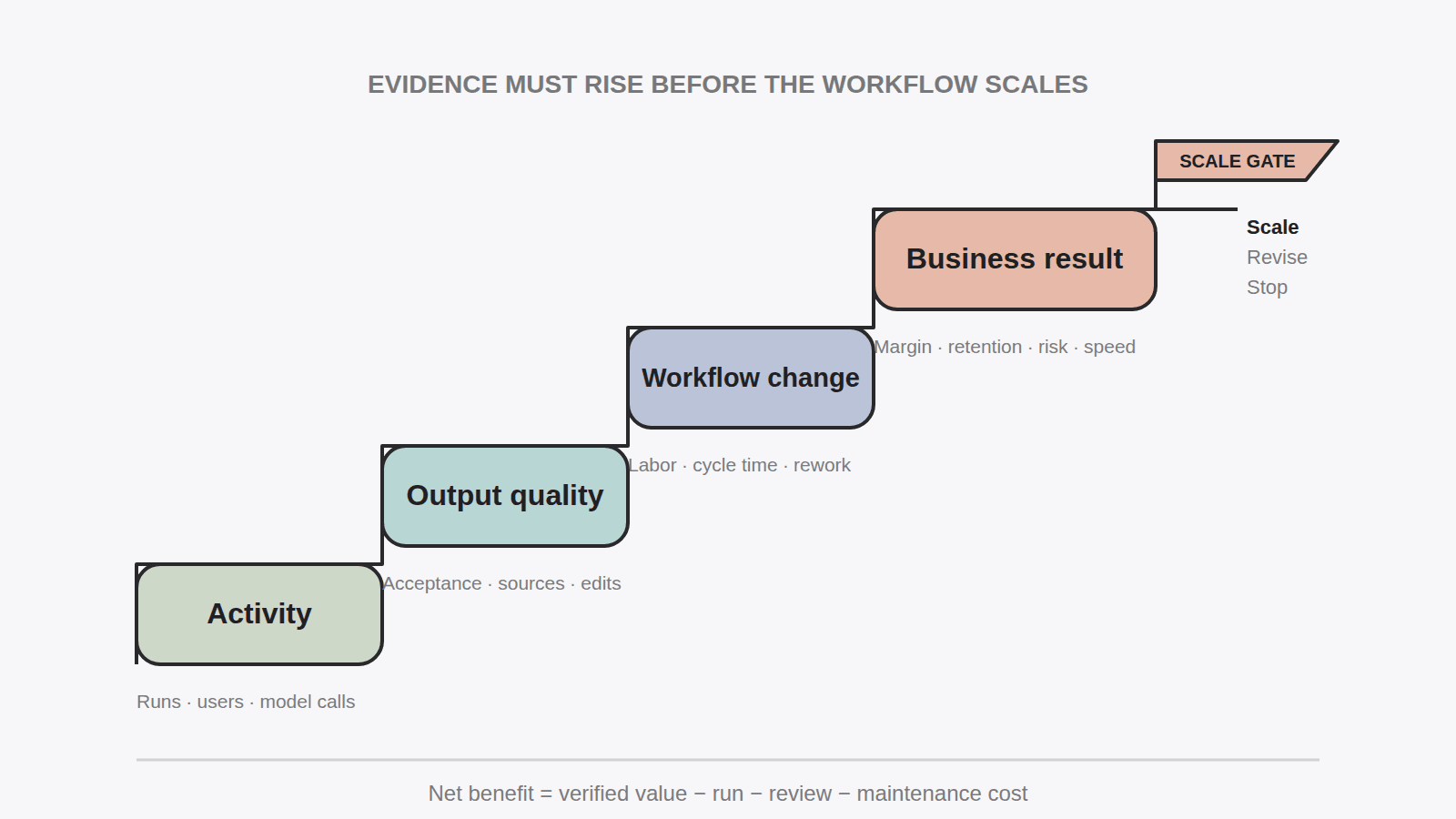
Figure 3. Usage starts the evidence chain; scale requires workflow and business results.
Activity is diagnostic, not ROI. A workflow can run 500 times and still create no value. Conversely, a monthly finance process may have low volume and a strong business case if it reduces close effort without weakening control.
The weekly website analytics example shows a sound evidence habit: cross-check two systems, isolate broken tracking from user behavior, and avoid claiming that a launch caused a metric change without experimental evidence. That discipline matters more than a polished dashboard.
For unit economics, vm0's guide to reducing AI agent costs separates model choice, run frequency, context, and external services. If product data must be analyzed, the masked, read-only database pattern shows how a lean team can preserve joinable operational facts without exposing raw production content.
Make one of three decisions at every review:
- Scale: net benefit is positive, controls hold, and adoption is stable.
- Revise: the outcome matters, but one source, instruction, handoff, or permission causes repeat failures.
- Stop: value is weak, risk is unacceptable, or review and maintenance consume the gain.
Where the operating model stalls
The portfolio starts before the first workflow works. A long roadmap feels strategic and spreads attention across owners who have not learned how to operate one production system. Finish one evidence loop first.
The tool owns the project. Vendors and internal platform teams can supply capability. A business owner must own the baseline, acceptance criteria, and outcome.
Automation arrives before the procedure. A trigger multiplies whatever is already there, including ambiguity and bad permissions. Run manually, pass shadow mode, then automate.
The baseline is reconstructed after launch. Memory favors the new process. Capture current volume, effort, defects, and cycle time before the first pilot run.
Review is ceremonial. Reviewers approve everything because they lack a checklist or cannot see the sources. Give them rejection authority and measure their edits.
Unknowns get converted into confident prose. Require evidence links, label missing data, and route unresolved cases to an owner. A correct “unknown” is a successful control.
The old workflow never ends. Staff complete the manual process and check the AI version on top. Adoption metrics and an explicit retirement decision expose this hidden cost.
Frequently Asked Questions
What is an AI transformation?
AI transformation is the redesign of business workflows, decisions, roles, and controls so AI contributes to measurable operating results. For a lean team, it starts with one owned production workflow and expands only after quality, risk, adoption, and economics are proven.
What are the 7 stages of AI?
There is no universal seven-stage model for AI itself. For organizational AI transformation, a practical seven-stage sequence is: inventory workflows, select one use case, baseline the current process, write the operating contract, run in shadow mode, release with human review, then scale, revise, or stop.
How do you implement AI in business?
Choose one recurring workflow with a verifiable output. Baseline its current cost and quality, limit data and permissions, define failure thresholds, test beside the human process, and move into production with a named owner. Broader AI adoption should follow evidence from that workflow.
What is AI digital transformation?
AI digital transformation means adding AI-driven judgment, generation, or prediction to processes that have already been digitized. Digital systems make data and processes available; AI changes how decisions and work happen inside them. That adds variable outputs, new review work, and a need for explicit evidence and risk controls.
The first move is small: name one recurring workflow, its owner, its output, and the action the system must never take alone. Zero's outcome-first operating model supports that path with connected execution, reusable workflows, separate triggers, and permission controls. The transformation still belongs to the team running the work.